Soft Tactile Sensing
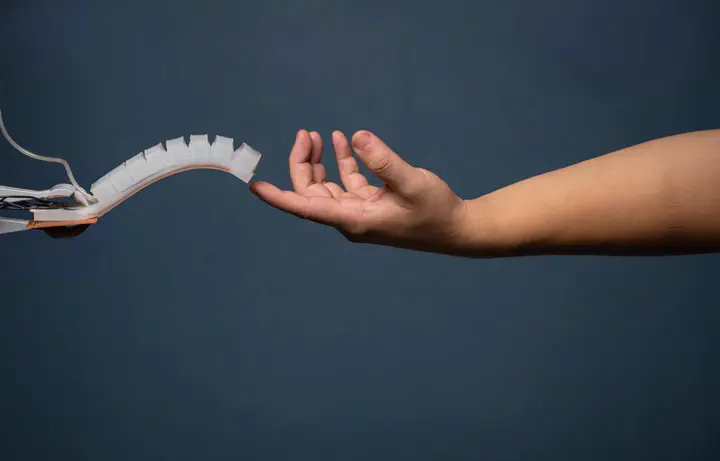
Soft Tactile Sensing
Robots need rich tactile information to interact safely and dexterously with the physical world. However, conventional tactile sensors can be difficult to scale to large, compliant surfaces because they often rely on dense arrays of discrete sensing elements and electronics.
Our research develops soft, large-area and high-density tactile sensing technologies for robotic systems. Our primary focus is electrical impedance tomography (EIT), which allows tactile information to be inferred from electrical measurements made through soft, conductive materials. This provides a route towards continuous tactile skins with sensing electronics located away from the contact surface.
Electrical Impedance Tomography
EIT is the main focus of our current tactile sensing research. Instead of placing a separate sensor at every point on a robotic surface, we embed conductive materials within soft structures and use measurements between a relatively small number of electrodes to reconstruct where and how the material has been deformed.
We are investigating new conductive soft materials, electrode architectures, reconstruction algorithms and learning-based methods to develop tactile skins that are:
- Large-area and highly scalable
- Soft, compliant and deformable
- High-density and spatially resolved
- Robust to damage and repeated deformation
- Capable of sensing multiple physical properties
- Suitable for real-time robotic applications
Our work explores EIT for sensing contact location, pressure, shear and deformation, as well as more complex interactions such as multilayer contact, damage and environmental changes.
A key research direction is increasing the information density of EIT-based tactile skins. By exploiting the large number of electrical measurements available from relatively few electrodes, we aim to create tactile systems capable of providing rich, distributed information across robotic hands, grippers and other soft structures.
Beyond EIT
Although EIT is the main focus of our research, we also explore complementary approaches to soft sensing. These include vision-based tactile sensing, magnetic sensing and other embedded sensing technologies.
Different sensing modalities offer different trade-offs in terms of spatial resolution, scalability, robustness, integration and computational complexity. We therefore investigate how different sensing principles can be used individually or combined to provide robots with richer information about their physical interactions.
From sensing to robotic intelligence
Ultimately, our goal is not simply to detect touch, but to give robots a richer sense of their physical interaction with the world.
We combine soft materials, sensor design, inverse methods, machine learning and robot control to develop tactile systems that can be integrated into robotic hands and manipulators and used for dexterous manipulation, physical interaction and embodied intelligence.
Research in action
Complex-shaped EIT-based tactile sensing
High-resolution, high-frequency EIT-based tactile sensors
Combining magnetic and vision-based technologies to create superhuman tactile sensors

Thomas George Thuruthel
Assistant Professor (Lecturer) in Robotics and AI
My research interests include soft robotics, control and machine learning