Soft Actuators
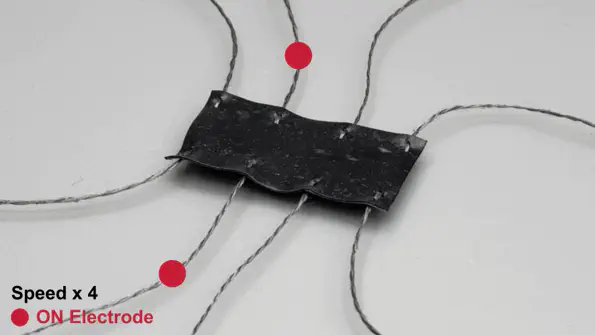
Soft actuators convert an applied stimulus — pressure, heat, an electric or magnetic field — directly into complex mechanical deformation, without the discrete joints and links of conventional actuators. This line of work looks at new soft actuator materials, fabrication routes, and the control strategies needed to make full use of their rich, high-dimensional deformation behavior.
Dynamic Current Routing in Conductive Liquid Crystal Elastomers for Complex Deformation Actuators
Liquid crystal elastomers (LCEs) can generate rich, three-dimensional deformations, making them attractive active materials for soft robotic actuation. Prior approaches to complex-shape LCE actuation have relied on either a single preprogrammed global shape, light-driven local stimulation, or multiple embedded circuits — each limited by bulky hardware, occlusion issues, or a hard cap on the number of achievable shapes. This work introduces dynamic current routing: a single, homogeneous, electrically conductive LCE surface with a small array of boundary electrodes, where selectively activating different electrode pairs (and sequences of pairs) creates distinct, localized Joule-heating patterns and therefore distinct 3D deformations, all without any embedded circuitry. A four-electrode actuator was shown to reliably produce its six predicted elemental deformation patterns, plus many more by switching electrode pairs mid-recovery, and an eight-electrode version scales this further. By sequencing these deformation patterns, the same uniaxial actuator was driven to travel in four directions and to rotate, using a data-driven approach to identify the best-performing electrode sequences for each direction. The result is a fully compliant, compact, and scalable actuation approach that decouples achievable deformation complexity from fabrication complexity, with potential applications in locomotion, grippers, artificial muscles, and haptic interfaces.
Paper — Gloria PouWai Lei, Morgan Barnes, Thomas George Thuruthel. Advanced Materials Technologies, 2026.

Thomas George Thuruthel
Associate Professor in Robotics and AI
My research interests include soft robotics, control and machine learning